
Serendip is an independent site partnering with faculty at multiple colleges and universities around the world. Happy exploring!

Evaluating my Ecological Imaginings
When we first began this experiment of Ecological Imaginings, I came in with the mindset of an Environmental Science student. For me this entitled having my head filled with ideas of doom and gloom in regards towards environmental collapse and the uphill struggle environmentalists had to fight socially and politically if they wanted to enact change. I came into the classroom then seeing the issue of the ecology in a scientific and polices-based point of view. Over the course of the semester though, I feel as though my viewpoint and this mindset began to change so that instead of obsessing about and analyzing the environmental issues , I started to place more emphasis in my learning in the class on trying to understand the concepts that I, as an environmentalist should be protecting. Namely, these concepts are nature itself, but also my general surroundings.
Understanding the Environmental Studies Curriculum
In the last couple weeks I have put a lot of thought into how we can teach our class, the student body of the Tri-College Consortium, and society in general to be more ecologically aware of the environment. I have spent most of my time talking about this in my last couple of web papers. In Hurricane Sandy, the Rotunda, and Thomas Berry, I contemplated our class’ reading of Thomas Berry and his idea of restructuring college level education to prioritize awareness of the natural world. Having felt a close proximity with nature while standing in the Haverford KINSC rotunda during a blackout, I concluded that having unplanned real world experiences like this outside of the classroom would be very useful for increasing environmental awareness. As Berry stresses how the entire system needs to be reworked, I started to wonder how his reforms for environmental-awareness education could be implemented for the best results. This came in the form of my next paper, Ecologically Reworking American Politics and Its Dynamics, where I tried to merge Berry’s proposal of a complete educational overhaul and my own idea real-world experiential education. Using Haverford College as a template, I proposed making every student take an environmental studies course as a graduation requirement so as to try and make all of the student body ecologically aware in some form or another.


Our Song!
Oh I’m done with school, I’m out of motivation
I’m walking through a fog of stifled dreams
There will always be something missing here
Falsely composed
Trying to ignore finals week hysteria, 99 problems, and more
Oh I’m ready to go forward
Ready or not here I come
Dreams are arising from the unconscious C
I'm I'm excited for what's to come
I'm facing reality finding new purpose in life
I want to live my life on my terms
I want to live full-heartedly
Falsely composed
Trying to ignore finals week hysteria, D99 problems, and more

Initial Self Reflection Post (Moved under title: "Self Reflection")
My self-reflection was posted here earlier - before I actually read the portfolio instructions to put it under a specified link!

What Walls Do We Build/Need/Break Down?--Our Final Presentations!
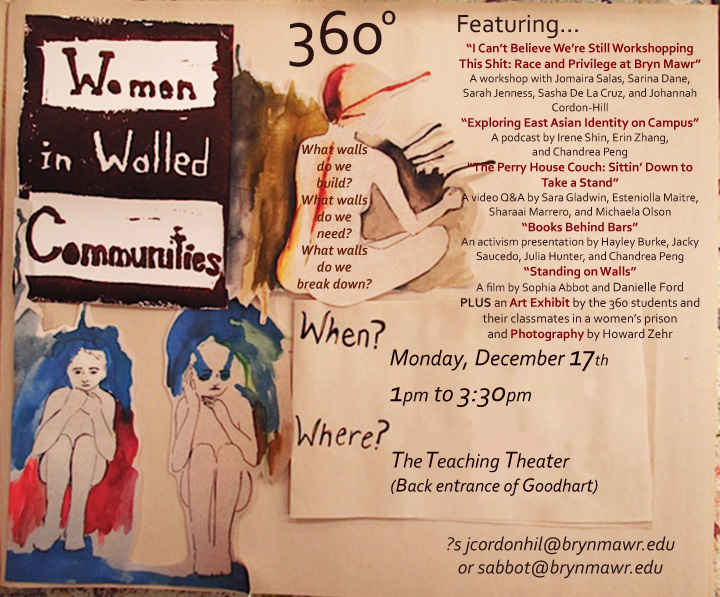
Welcome everybody! We're happy that you’ve joined us here to see what we've learned in our 360° this semester. A 360° is a cluster of interdisciplinary courses that look at one main theme. Ours is called Women in Walled Communities.
In The Rhetorics of Silence, we examined the many functions and meanings of silence: as a political tool, an imaginative space, and a powerful form of communicative expression--as well as the result of lack of agency and or the denial of voice.
In Learning in Institutional Spaces, we explored how the institutions of schools and prisons promote or inhibit learning. It was in this course that we looked most critically at this institution, Bryn Mawr College, and its own history of power and oppression, which sparked a lot of interest in Perry House as an embodiment of some of that history.

Don't overestimate the amount of food you need, guests!
I am very very upset after two lunch shifts at Wyndham this week...Not just that I have to work in the middle of the day during final week, but to see how much food are wasted in only two hours. Now I totally understand the green project a couple of weeks ago that demonstrated how much food we just throw away on a daily basis. When I have meals at dining halls, I also have this habit to take whatever looks attractive and may or may not finish it at all. Sometimes, I have to waste food because the food doesn't taste what I have imagined. But seriously, people are taking too much some time...And it is hard to see that only looking at your own plate. But the kitchen is clearing the plates like crazy and nearly 20% of them are full when people are done with the meal (roughly estimated by me, could be very misleading but indeed there are lots of such cases). We will be having meals at the dining halls for most of the time at Bryn Mawr, maybe take some time to note how much you exactly need for each meal? Also in response to the budget cut these days...Everyone should experience working at a dining hall some time... Really, this is the most direct way to see how much we waste EVERY MEAL! (May be a suggestion for the field work for the course.)

All good things...
Danielle Ford
12.19.2012
360 reflection
Reviewing the posts and papers I wrote at the start of the semester reminded me of the mental state I’d been in. I had just returned to Bryn Mawr after a semester abroad -- at an institution in which students had no voice whatsoever and I hadn’t met a single person who thought gender expression was a social construction (that is probably an unfair way to judge a culture -- but it is very important to me)... then, three months of education work on an urban farm and a month living on an anarchist intentional community in North Carolina. It was strange to feel like I had even a semi-permanent residence. I was re-joining a familiar institution with a new, more radical lens. This is evident in the first papers I wrote for Jody, about unschooling and resisting the words/roles “teacher” and “student.” Also, my first memo for Barb was a frustrated rant containing a lot of what I had learned about the criminal justice system through Occupy and Anarchist info-sessions. Radical energy was radiating out of me. This 360 has been wonderful for me in that it helped me express that energy --- to figure out how to communicate it productively.


Remote Ready Biology Learning Activities

Remote Ready Biology Learning Activities has 50 remote-ready activities, which work for either your classroom or remote teaching.
What's New? Subscribe to Serendip Studio
A Random Walk
New Topics
-
5 days 18 hours ago
-
5 days 18 hours ago
-
5 days 18 hours ago
-
5 days 18 hours ago
-
1 week 1 day ago
