
Serendip is an independent site partnering with faculty at multiple colleges and universities around the world. Happy exploring!

Preparing to Hibernate
When I set out for my site sit today, some part of me is happy that this is my last one. It is Sunday morning and everything is grey, everything is cold, and everything is wet. I did not start out happy sitting under the bench near the labyrinth. The only thing that cheered me up is, "At least I don't have to do this any more. It's getting too cold for this." But then, of course, I realized what it really means that this is my last site sit. No more medatative hours just watching the world do its thing. No more little squirrels hopping about. No more labyrinth watching. So maybe while it's cold I will keep away from any site sitting, but when the world warms again for spring maybe I'll come out of hibernation and enjoy the peace that is a site sit.

Questioning Wandering Learning

Questioning, Wandering, Learning
Why go to college? Why spent thousands of dollars and four years of youth for rigorous academic works? Conventional wisdom says attending colleges and universities is the key to a successful life. Young people can gain knowledge and skills they use for the rest of life. However, a recent survey by Pew Research Center show that 57% of Americans say colleges fail to provide students with good value for money spent. Herein is the problem I detected: when viewing higher education with narrow lens of cost effectiveness and monetary payoff, people are blinded from the real aim of higher education: to teach people to think ecologically, to see the conflicts within our ecosystem and to ponder the questions for the rest of their lives. I believe higher education is not limited to the several years of schooling but a life-long education, and higher education is not merely keys to successful lives but meaningful lives filled with curiosities, wanderings and new findings.

Last One
The backyard of the English house was covered in a thin layer of fog, on Saturday morning. The majority of the trees were completely bare of their leaves. The small tree with shiny leaves still had all of its leaves, they seemed to be more green than ever in the midst of the grey fog and the brown branches that surrounded it. The vines that hugged some of the trees was still alive and green. This was my last site sit and everything was damp and sad. I was slightly saddened by the fact that this was to be my last site sit (although it did not have to be, I can go back to the Backyard of the English house anytime I please, really). I would like to think that everything behind the English House was saddened by this fact as well, and that they would miss semi-scheduled presence. Everything sure did look pretty sad back there. The grass was more droopy than usual, the trees hid themselves in fog, and everything was damp. But perhaps I’m just being self centered.


Fielding
Guides for fielding, co-fielding, co-guiding, following, co-following, mutuality, reflection...
When do we need a guide? When do we guide ourselves?
We started the semester with Solnit's "Field Guide for getting lost" - and now, I think we are starting to create our own guidebooks/methods for discovery. Though it was time consuming, deciding together how to structure our outings was a way of writing out our expectations and procedures… and while some of them didn't work exactly the way we wanted, I think the process of making group decisions was worthwhile.
When we went to Ashbridge Park, we self-selected different activities to provide for the group - choosing how/when to be leaders. And choosing to let Carmen be our leader/guide/mentor - I think this is also a form of self-efficacy.
1. Ashbridge Memorial Park - Field Trip
Trip: planned, activities, structure/purpose, destination

Watch out and Enjoy
I did not expect such a dramatic, unpleasant yet amusing experience for the last site sit for our ESem. I planned on taking pictures from faraway and close up since most of the time I stayed just at the Labyrinth, which is a rather confined space. I wanted to step back and look at the Labyrinth, in hopes to see something new. I started from the Campus Center and then crossed the Senior Row and reached the Labyrinth. I have always had hard time to orient myself in the area around the Labyrinth. From looking far away, I realized actually it was a very small space. It was the trees and slopes disguised the Labyrinth, making it seem to be sophisticated and unapproachable. I was so absorbed in the walk. Even winter is the season for lives, I could perc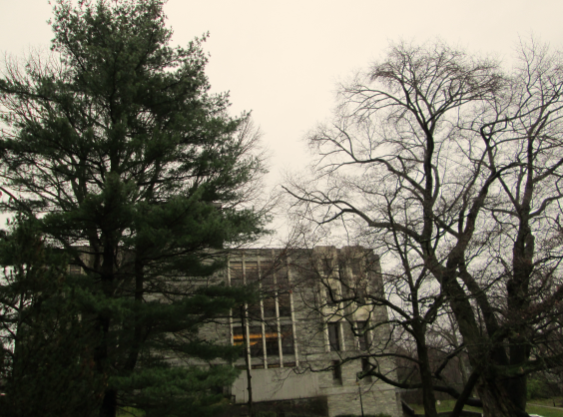 e the activities going on of the creatures around me.
Maybe I was not outdoorsy enough to manage taking photo and walking on the muddy ground at the same time in a rainy day. Yes I slipped over and fell to the ground when I walked downhill...Obviously I did not feel so well. But I was not frustrated by this little accident - that must be my closest moment to the nature during this semester's site sit! I sat on the ground, looked up to the trees and the sky ,and thought there must be no way to escape from the control of nature and my unpredictable life...

The Vendetta Lost
Who am I? I have yet to figure that out. My role in the world, the universe, the environment, is still a question mark. Life is constantly changing, people die every day, and rarely do we think our family members will be the ones dying. Life adjustments need to be made as our lives plug further and further along. Rebecca Solnit proposes an answer to this question. In order to find oneself one needs to become lost. Where? When? And how does one go about doing this? Does a structured system such as a college allow us to openly search as Solnit suggests that one must do? Does Bryn Mawr College’s concrete, structured education provide room for what Solnit proposes in her Field Guide to Getting Lost. Which way is the best way to explore the self and can Solnit’s ideas coexist in a fixed college environment?

More Thoughts on Silence
From the beginning of our 360 experience, I have always been curious as to why we, including myself at times, are uncomfortable with silence. I guess over the weeks, I have found general answers to this question especially from Chittister when she says, "Silence frightens us because it is silence that brings us face to face with ourselves." However, this does not give me any specific reasons. What about ourselves do we not want to face? Is it always something bad, for example a heartache or is it, at times, a positive--innate goodness? Why wouldn't we want to face the positive? What is questioned or what fundamental beliefs are challenged when we fully immerse ourselves in silence alone and with others?
I agreed with Chittister when she said that, in essence, daily noises "protect us from listenig to ourselves" but I think this statement does not acknowledge that the individual who is surrounded by noise has agency. It is not that the environment around us is forcing its noises on us, I feel like it is more of individuals allowing it to do so. As Professor Beard said, silence is "hardly quiet" so how and why do people go about choosing which noises, external or internal, they want to hear?

What does a nun look like? Sound like?
My main Sunday post is here in response to Chandrea's but I just wanted to throw something extra out there. My friend, who is a student consultant one of the college's search committee for new professors, was shocked to find out that Linda-Susan, who has a position on the same committee, is a nun. I was intrigued that this fact had never come up in the many conversations they'd had together. After telling my friend about the topic of our discussion on Thursday, I asked if Linda-Susan seemed especially contemplative to her. This came out of Linda-Susan's answer to my question that the Sisters at her monastary take strides to bring contemplation and contemplative conversations into places that they don't seem to exist. While of course this was probably not something that could be exeptionally visible to my friend, she did say something interesting in that Linda-Susan often "played devil's advocate" during their discussions. So now I'm wondering -- what place does pushing back have in contemplation? Where does disagreement fit in? By playing devil's advocate does Linda-Susan attempt to prompt her colleagues into deeper contempation over a subject?
Rainy sunday morning
This morning I woke up without a slightest want to get up. Tangled in the bed, I checked weather forecast on my phone. 43F with rain… Oh I could hear the sound of the rain and could feel the freezing wind sneaking through the window. But well it not the right time to be a lazy cat though, I told myself. So with a cup of hot coffee, I visited my site, for the last time it was still a “site-sit”! In comparison with the first time I was there, the scene has obviously changed. Seasonal change. September weather was hot and the surrounding was lively and colorful. But today it is raining. No sun. Less green. Less colorful. The trees lost their leaves and the grass does not look very “happy.” But perhaps September next year when I come back to the place things will return to the beginning state when I got to know them. Or maybe not. Perhaps my perception and impression of nature is also influenced by my own feelings and my own thoughts? Next year when I come back, September was not the September the first year at college with all the excitement. I wonder what Rhoads will be like to me then? And even years after that?

Remote Ready Biology Learning Activities

Remote Ready Biology Learning Activities has 50 remote-ready activities, which work for either your classroom or remote teaching.
What's New? Subscribe to Serendip Studio
A Random Walk
New Topics
-
5 days 22 hours ago
-
5 days 22 hours ago
-
5 days 22 hours ago
-
5 days 22 hours ago
-
1 week 1 day ago
