
Serendip is an independent site partnering with faculty at multiple colleges and universities around the world. Happy exploring!

Two Silences
Sometimes people talk all the time in class, while still staying silent.
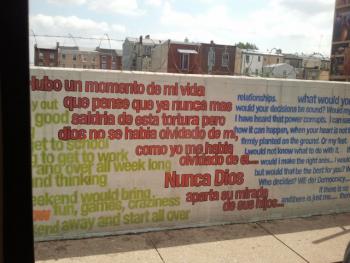
Class discussion is about sharing thoughts and ideas, but sometimes it is also about sharing yourself. Now that we are already three weeks into the 360 experience, it is becoming incredibly clear that more than one kind of dialogue occurs in our classrooms. This is true of many discussion-based class settings, but the intimacy and intensity of our cluster of courses makes these different kinds of sharing even more apparent. What I am still not sure of – but am very interested in exploring – is to what extent these two modes of discussion are intertwined, and whether one is even possible to do one without the other. Dissecting and analyzing readings or books on their own is important (and is what I am usually referring to when I talk about class discussion). But telling personal anecdotes, and relating readings, theory, and overarching concepts to our own lived experiences gives a window into how we relate the subject matter to who we are.

Floating mind
I am sitting on the outdoor bench, feeling the cool, autumn wind. I can see my shadow changes with the varying position of the sun and the cloud. For once in my life, I would like to forget about the physics model of earth orbiting around the sun, and believe that the sun is, miraculously, orbiting the world I am living in. This idea warms my heart, as I felt there id always something, someone surrounding me, protecting me, comforting me.
Many students are practicing sports on the playing ground—they are so passionately, enthusiastically in love with what they are doing, and I could not even describe how ridiculous mechanism seems to me. People are doing sports, not because they are programmed to do so. Their instinct is not a CPU, and they are not emotionless robots that mechanically do everything they are told to do. They have soul. They are a part of my sight, my world. They made the playfield full of happiness—they changed, rather than adapted to the surroundings.
They remind me of a girl in my junior middle school. She was a good friend of mine, and I always encouraged her when she got depressed. She was so easy to get depressed, because of her lpw grades, not-so-good appearance, unsatisfying popularity, and so on. She was so easy to be affected by the weather, or other people’s words. Then, when she got depressed, she spread her negative emotions to other people. At first she was sympathized, but after she created a trap of depress for herself, she was more and more isolated.

A Fear of Silence?
I have been thinking a lot about how I can incorporate silence into my daily routine. I think if I can be more comfortable in silence I will be able to experience more fully, rather than distancing myself from an experience by constantly reflecting, interpreting and assigning it language.

Reaction to Saturday
Saturday was a very long exhausting day for me. I loved the mural tour; even though I found myself paying more attention to the people I saw rather than the murals itself. My favorite part of the day though, was the Eastern State Pen tour. As the tour continued I kept getting more and more frustrated, not with the tour, not with the tour guide – but with society. Walking around hearing the stories reminded me of how someway somehow society finds a way to turn good into bad.
I kept imagining these prisoners in those cells and kept connecting it to modern day incarceration and how inhumane it has become. The numbers of incarcerated people still shocks me no matter how many times I hear them. It also made me think about how prisoners first started being all White, and then there was a complete 180-degree turn that flipped the population in prisons from White to those of color. It makes me wonder if there will ever be a way of stopping this without giving birth to another type of modern day slavery.

Rethinking Anthropocentric
The one key term that I kept coming back to when re-reading the beginning of my web-paper was “anthropocentric.” I freely admit in my first paragraph that I am the lens that I use to observe the campus on my walk. I use the words “I” and “my” fourteen times in the first paragraph alone.
In order to re-focus my thoughts, I chose three entirely new words through which to view this experience. These words are: “interaction”, “resilience”, and “community.”

23Sept2012S3: What gets left at the door
I've always thought a lot about "what gets left at the door" when entering (or leaving) a classroom that fosters growth, enrichment, education. To frame question in a different way, a way that reveals how I believe this topic is pertinent to our class theme, I’ve thought a lot about what topics and at what times we should remain silent in the classroom. This post is to express my thoughts on this in relation to our experience together this past week.
As I think we all know, a type of objectivity, lack of emotion and personal investment, and reason is valued in the classroom. The reasons are easy to point out: doing so allows us to remain concentrated on the subject matter at hand. What’s more, this allows the classroom a freedom to discuss and debate without the worry that sentimental opinions and feelings will hinder the intellectual pursuit. Phrases and thoughts like “Leave your baggage at the door, otherwise, you won’t contribute to the classroom appropriately” or “Don’t speak about how you’re sad or about your personal life, that has nothing to do with our readings”, to the “Well, shit, now I definitely can’t say anything; I’m just going to hurt your feelings” all hopefully elucidate what I mean. Academia believes that emotions and our personal self get in the way of intellectual pursuit.

waiting to speak?
Looking back and rereading my initial essay, silence has since taken on a bigger definition, a wider range of activities and has also become a more comfortable topic for me. When I was writing my first essay, my thoughts of silence and being silenced all strung back to events of feeling silenced or silencing because it would be more convenient for others and me to not speak up. In my history of silence, it has been more convenient for me to stay silent because I felt I was wasting my breath and thoughts on attempts to comment on people’s comments. I don’t think I was trying to “correct them” but I guess I felt like it could sound like it. But with that, I didn’t feel like I was being listened to, I felt like they would be waiting for their turn to speak.

In/visible mountains
After I posted this image, Anne directed me to the “Women in walled communities” 360. I’ve been thinking more about the school as an institution (which, for me, has negative connotations), keeping us walled in. Is there an invisible wall in my 'Sound of Music' image? The mountains as a geographical/physical/visible obstacle, the convent as ideological/mental/invisible obstacle?
Am I resilient to these walls? By selecting an image that shows some sort of twisted freedom, I think that, perhaps, I am actively resisting that invisible structure.
On another note, I would categorize my image as anthropocentric – I chose an image centered on my human experience of Bryn Mawr; that is, one of emotional constraints and freedoms, imposed by other humans and the physical structures that house this campus/institution. Even though I chose to foreground and background different aspects, the campus is still designed (tweaked and treated with specific regard to human life and convenience) around people, so why shouldn’t I map it in this way?
Paper 2
As I re-read the prompt for this paper (which was about a thousand times), I still have trouble understanding it and even coming up with an answer. Ever since we started class, I have been having trouble visualizing silence. I understand it to be the inability to speak/express yourself, either because you do not want to or because someone/something won’t let you. I read almost all the papers that are already posted to see if I can get an idea of what to write about, or what the question is asking. After reading the papers, I still do not have an answer, which (with a little help from Sarah) led me to conclude that the openness/vagueness of the question is silencing me.
I guess I can relate this predicament to my academic life here at Bryn Mawr. A lot of the times, if not all the time, when there is an assignment, it takes me a while to completely comprehend what is being asked. This makes me think of our last class when we spoke about the different levels of comprehension and “education” in all of my classes. If there were a time where I am silenced in a classroom, it would definitely be when I am being asked to reason or think about something that is fairly foreign to me.

Visiting the Visual Again
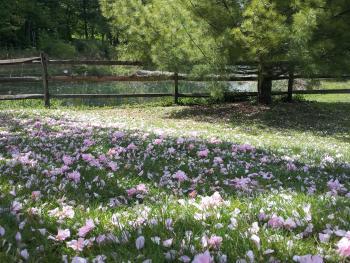 Looking back at my images, this one does seem more anthropocentric than the second, if I view it from a smaller animal's perspective. Around Rhoad's Pond, there aren't many animals that would be able to see the grass, blossoms, and lake from the angle this photo takes. I was kneeling on my knees when I took this picture, because I wanted to get the trees, grass, petals, fence, and lake all in one image. I wanted to encompass the surroundings in this photo. In deciding which pict to post the first time, I had a hard time deciding between this and the second, because I had a feeling somehow that this one was not as specific to the sight, or seemed to not fit somehow. Now I realize perhaps why I felt that way.

Remote Ready Biology Learning Activities

Remote Ready Biology Learning Activities has 50 remote-ready activities, which work for either your classroom or remote teaching.
What's New? Subscribe to Serendip Studio
A Random Walk
New Topics
-
6 days 18 hours ago
-
6 days 18 hours ago
-
6 days 18 hours ago
-
6 days 18 hours ago
-
1 week 2 days ago
