
Serendip is an independent site partnering with faculty at multiple colleges and universities around the world. Happy exploring!

"Writing White"
"...if our option is for (wo)man, education is cultural action for freedom..." ---Paulo Freire Saturday, I began my first day on the job as a MAST writing tutor to high school students excited at the chance to be a resource and mentor to four brilliant, students of color. Not wanting to impose, as Ivan Illich would say, my views around education, teaching, and, of course, literacy, I gave my students the freedom to design the writing curriculum and classroom space.I was very pleased with the outcome! My students wanted to learn how to write resumes, research papers, SAT prompts, and to write poetry! I was extremely impressed, not because their answers were not expected, but because I definitely did not worry so much about these things my freshman year of high school. Before the start of class, I had been instructed by my superiors to collect writing samples from my students. And so, on a topic of their choice, they each wrote a one page argumentative paper. However, when reading their writing samples, I became incredibly sad and discouraged as a tutor. My kids, who knew what was expected of them academically and even professionally, did not know how to write "well." It was more than grammar and spelling (these areas could be worked on easily), it was the style, the flow, the tone, the words used in their writing that I knew would be looked down upon in higher education. They had not mastered what one of my students had labeled as, "white writing."

Mass Protests and Crowd Intelligence
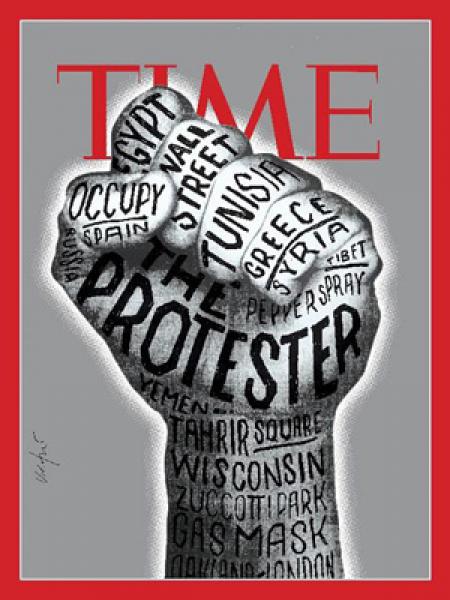
In the Digital Humanities Manifesto 2.0, the word “manifesto” from manus or hand helped me relate the mass 2011 protests, such as those in the Arab Spring and Occupy, to the digital humanities. As fists reaching out for freedom and equality against corruption and unemployment in a mass protest, a similar hand reaches out for the freedom of the spoken word and the common share of ideas in the digital humanities. In a protest, a hand is not to be distinguished from the others around it as each one joins the others in a wave of fists for a common cause. Similarly, one person’s words and ideas in the digital platform matter, but how they connect to others' and their derived linkages create the multimedia network of “innovative thinking” that makes up the digital humanities. The emphasis of the ant colony instead of the Ivory Tower in the digital humanities reminded me of a book on complexity science (more about it here) that demonstrates the intelligence of crowds and how ant colony and swarm behavior can be used to determine the logic behind networks.


Some thoughts on Woolf's "poverty".
Since our class on Thursday, I have been thinking about Woolf's definition of poverty as a virtue that is necessary for education. My intitial reaction to her definition of poverty as having just enough to be independant, and wanting nothing more, was very emotional. This is, I'm sure, a reaction that was fed by my own lack of independence at this point. I read Three Guineas while trying to navigate a semester that has started with me being without working heat or hot water for 3 weeks, and with me worrying constantly about whether I will have enough gas to make it to campus for class. I missed the first class discussion of the book because someone had to stay home to wait for a plumber to look at our furnace, and no one else in my house could afford to miss work. I say this, not to garner sympathy, but to say that, though I was frustrated and insulted by Woolf's definition, and by her insistence that such poverty would be a virtue, perhaps she was somewhat right.

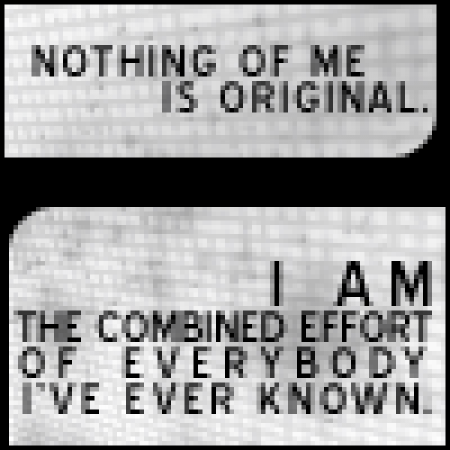
Nothing of me is original...
In class on Thursday, it was discussed that it was possible to be individual, collaborative, original, and using common treasury all at the same time; that possibly, we don’t necessarily always have to classify any given type of writing into these four things.
With the help of the internet, I believe that the lines between these four things will blur even more within the next few years. Coming along this, will be more problems concerning authorship, since using the common treasury can be easy, and claiming this thing as originally yours, is even easier. It’s already hard to identify the real source of an idea. If information and ideas are readily available in the palm of our hands—quite literally, when talking about the iphone, tablets, and smartphones—what is to stop anyone from “unconsciously” plagiarizing. Digital writing, in a sense, will also be like a database. There might not even be a distinction from one person to another.
Take, for example, Tumblr. I use Tumblr, and I often find myself “re-blogging” posts that others have blogged before me. Yes, you can easily trace down the original source, because Tumblr keeps track of where each person gets it, but does that really make a difference? When I find a post that I want to re-blog, I don’t bother looking for the original poster. No, I don’t give credit to the person before me, since I know she didn’t make it up either, but by merely putting it on my blog, aren’t I also claiming it as my own, as part of something that is an extension of myself, by posting it on my blog?

Symposium on The Contemporary Performance of Sex, Gender and Embodiment: 1-5 p.m., Sat, Feb. 18
In connection with the world premiere performances of Fort Blossom Revisited 2000/2012 by John Jasperse Company February 24-26, Bryn Mawr College will host a Symposium on The Contemporary Performance of Sex, Gender and Embodiment on Saturday February 18, 2012 from 1-5pm in the Hepburn Teaching Theater, Goodhart Hall. Admission is free and open to all.
Fort Blossom (2000), choreographed and designed by Jasperse, is a 40-minute work in which the audience is invited to examine contemporary notions of how we experience the body as both owners and spectators. Simultaneously shocking and beautiful, it is being revisited and expanded into a 60-minute piece with lead support from Bryn Mawr College, funded by The Pew of Center for Arts & Heritage through Dance Advance. The slow, sustained angling and partnering of nude dancers in Fort Blossom present direct and un-commodified experiences of the body alone and in relationship. Jasperse wrote that the work "sought to dilute the transgressive impact of the body--to allow us to perceptually acknowledge the body in all its facets as simultaneously special, even miraculous, and ordinary.” To reflect on the questions raised by Fort Blossom, Bryn Mawr hosts this one day Symposium with presentations, panel discussions and video viewings.
Presenting scholars and artists:

Creative Criteria?
Last Thursday all of my professors seemed to have read the same memo. After our morning class, I went straight to Philosophy of Creativity and then to Philosophy and the Good Life, and in each class we discussed creative origin and if there is such a thing as originality. Needless to say, after that five hour run, my head was oozing with philosophical juices, which made for a pretty bad headache. Don’t get me wrong, I love pondering unanswerable questions, but pondering the same unanswerable question in three different classes was a bit much for the second week of classes.
Now that I’ve had some time to digest the question of originality, I’d like to ask what are the criteria for an original act? It would seem to me that to be original, something must reference the familiar (like we said in class), while adding a “newness” to a previous tradition, as well as have an author/artist’s intent that may or may not be fully known by the artist at the start of their creation. This is my temporary criteria, being that I’m likely to change my mind and because there is so much that I don’t know. To demonstrate my temporary criteria, I’ve attached a YouTube video, which I stumbled upon, being that I’m a YouTube addict.

Welcome
Welcome Parkway and Bryn Mawr students! Get excited to work together for the duration of this semester! Your first post for this semester is to write about your hopes for our shared learning for this semester. If you have been part of this partnership before- please let us know.

What's the origin?
In thinking about, expanding and revising my current conceptions of literacy, I have come to question just why it matters so much, or more specifically where the necessity came from. Obviously in this day and age it matters. It matters who speaks the “dominant” language; it matters who speaks it in the “right way;” it matters who will not ever have the chance. As we have learned, literacy and power, colonialism, patriarchy and oppression are all interrelated, always. You cannot separate “cultural capital” from the conception of using language “correctly” and thus effectively. During class we have begun critiquing the power structures and hierarchies that are so intrinsic within our system, the mentalities that are so central to the debate over literacy and the need to define one particular “right” way. We acknowledge that such necessities exist. My question is—why? Where does this need to hierarchize come from? Is it a western, white, patriarchal ideal—simply because those are the people who benefit? Something that these people devised and managed to convince the rest of the world to buy into? Or is the competition somehow more central to human nature universally? Perhaps harkening back to the survival of the fittest mentality. Today we live by a series of rules, constraints that determine who has power and who does not. But who originally had the ability to decide that their way was the right way? Who came up with the definitions in the first place? I have no answers to these questions but I am curious.

Arrogant Perception
- Understanding the Arrogant Persepction
I want to understand this term used by Maria Lugones by first putting emphasis on the word perception instead of the word arrogant which is its descriptor. When first trying to understand this term, I began by discussing the word arrogant before the word perception and my understanding of the text became confusing. However, when putting the emphasis on perception it is easier to begin thinking about how this applies at large to feminist epistemology, colonialism, power, education, etc. despite each of these entities being at times very different from one another. However, they all relate in the sense that how we perceive the world, our perception of the world is colored by hegemonic ideologies that are created and reproduced by people with power. As sociologist C. Wright Mills discusses in his book, The Power Elite, it is the select few with the most cultural, social and monetary capital that create the hegemonic perspective. Ordinary people, the majority of people, except a small population of the intellectual bourgeoisie, as Pierre Bourdieu discusses, consumes thoughts with little doubt or reflection as to who created these ideals and beliefs and for what reasons. The word arrogant then makes more sense in that those who have the power to create perspective, shape them, infiltrate them are those who are arrogant.

Remote Ready Biology Learning Activities

Remote Ready Biology Learning Activities has 50 remote-ready activities, which work for either your classroom or remote teaching.
What's New? Subscribe to Serendip Studio
A Random Walk
New Topics
-
1 week 20 hours ago
-
1 week 20 hours ago
-
1 week 20 hours ago
-
1 week 20 hours ago
-
1 week 3 days ago
