
Serendip is an independent site partnering with faculty at multiple colleges and universities around the world. Happy exploring!

To Subvert With Pomegranate
Phoenix
MLord
Play in the City 028
Tuesday, October 1, 2013
To Subvert With Pomegranate
As a player in the city, I “explore what is permissible and what pushes at that boundary between rules and expectations” (Flanagan 13). For a long time now, I have understood instinctively that art, to me, is a way of surprising people. The first person who put this sensation into words was Dorothy Allison in her essay, "This is Our World." Allison described art as a way to challenge and to cause people to think about the ideas that they prefer to shove aside and pretend don't exist. My reaction to this was an intense sense of "I'm not the only one." According to Mary Flanagan, not only am I not the only one, I come from a long line of artists who see art as their tool to shock and surprise—their instrument of Duchamp’s “spirit of revolt” (3). “As the connection between art and critical play continues, artists will further explore embodied play and situations in and efforts to ‘unplay’ preconceived notions of…everyday living, and rework them” (Flanagan 148). Preconceived notions are exactly what I have been fighting, armed only with a pineapple and a pomegranate.

Street Intervention
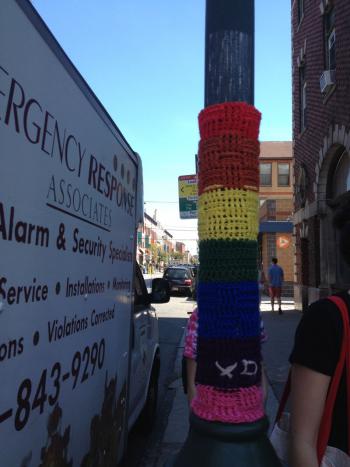 “Artists make words touchable, create palindromes, do street intervention, and even skywrite from airplanes to disrupt the everyday actions in the city.” Flanagan, 14
There is something defiant about Isaiah Zagar’s mosaics. Cities are built for efficiency, functionality, but not necessarily beauty. Yet, around South Street, a glimmer of light in the gap between two buildings could mean a mosaic of mirrors and color. Zagar’s art is a street intervention, playfully ignoring Philadelphia’s figurative and literal grids to bring a different dimension into its streets.
Zagar’s mosaics are inherently spontaneous. He doesn’t always plan ahead where his next mosaic will be, what it will look like, or where he will get his materials. Many of his mosaics spill across alleyways and onto the back walls of houses, creeping along fence lines as if they’re no longer in the artist’s control. The mosaics fill cracks in alleys with seemingly random words and images. Looking at a map of Zagar’s mosaics is not like looking at a map of a typical art gallery. The mosaics make no distinctive pattern and many do not even appear on the map. In the magic gardens, the route you take is not restricted to a path. Zagar’s art defies the city’s nearly symmetrical grid pattern in its meandering nature.

Quiet Critical Play
In Mary Flanagan’s book Critical Play, she addresses the connection between the artistic movement of Fluxus and the concept of critical play. Broader than the fluxus movement, theatre in general can be a form of critical play. Flanagan speaks to this connection, and could have easily included the genre of autoteatro in her writing. A few weeks ago I was a part of the “The Quiet Volume,” a theatre piece by Ant Hampton and Tim Etchells, which incorporates text and audio to guide the audience. “The Quiet Volume” has all the hallmarks of Flanagan-approved critical play: not only is it exciting and playful, but it is critical in that it creates a space where the participants can question a basic aspect of human life. In this case, it is reading. Where we read, how we read, and the nature of words is explored through “The Quiet Volume.” Flanagan would define this as critical play.

Connecting the Dots
Jessica Bernal
Play in the City-ESEM
Connecting the dots
All I needed to learn in life to survive, I learned in third grade. Mrs. Washington, my third grade teacher, she deserved teacher of the year awards and perhaps a life supply of Diet Coke just to keep her smiling. That woman had been teaching for twenty-two years and still got out of her red Buick every morning. She meant well and of course wanted the best for a couple of eight year olds, which at that time just meant making it to high school alive. I learned what R&B music was like and how within minutes the rhythm would sway your body side to side. I learned why my best friend’s hair didn’t feel or look like mine and most importantly, why she was darker than I. She wasn’t the ideal teacher parents would want their kids in school with. Instead of focusing on fractions and spelling the hardest words imaginable, we’d watch movies. I learned more from watching those movies than I would’ve learned from any show on PBS or the Discovery Channel for that matter.
I learned to take a step back from it all and letting the play unfold character by character and each scene connecting to each other like connecting dots. Once the movie starts, everything in the room fades and everyone disappears into dust.

Is All Art Play?
It’s obvious that kids on a playground are playing. They are running around, bumping each other, screaming, carousing, and often having the time of their young lives. But what makes all of those different activities they take part in fall under the umbrella term of play? Is it the physicality, the human companions, or even the entertainment value? If those things are the definition of play, than many adults have not played for years. So many of the games and activities in a child’s world are nonexistent in an adult’s, yet adults are nonetheless capable of play just as much as kids.

"The Spectator Makes The Picture"
When I was reading Flanagan's Critical Play, a quote from French-American artist, Marcel Duchamp, immediately caught my attention. "The spectator makes the picture (Critical Play, Page 10)." This is exactly how I felt as for my recent trips to the city of Philadelphia.
In my very first trip along Benjamin Franklin Parkway, I had a variety of "spectator experiences" with my classmates. At the Museum of Art, we saw a group of men racing to the top of the stairs, whilst their lady friends were cheering at the finish line. Their playful activity made a real-life art. Witnessing the process of their play of art, some audience outside the museum dismissed their play and found no value in their race, but I enjoyed watching them running on the stairs. It's such a special moment for me to see adults play freely regardless of other people's thoughts. But my idea could be largely different with my friends' opinions. This explains what Duchamp's meant in his words.
Spectators all have their own interpretations regarding to every piece of art. Some might agree with the artist's ideas. Others may envision a completely fresh sense. They can even add new meanings and new aspects to it, creating their unique version through this original piece.

The Laws of Chance
Little pieces of paper fall down and scatter across the floor. Pictures and memories are torn apart and delicately released to find their own path. Each ripped up chunk by itself is meaningless, its story hidden beyond the incomplete edges. Once all the small fragments come together on the ground they become something new, though not in the traditional way. Once the pile is formed, they are merely an abstract mess of torn papers, waiting for someone to come along and see them as something more.
This is the process that the Dada artist Hans Arp used in his Collage Arranged According to the Laws of Chance as mentioned in Chapter 5 of Mary Flanagan’s Critical Play. Flanagan said that “In his automatic processes, Arp would draw, rip the drawings into pieces, allow the pieces to fall where they may, and affix them where they lay as a memento of the operation.” In both of my excursions into the city of Philadelphia, this quote was represented in various ways that gave both the experience and the quote greater significance for me.

Playing with Flanagan
Flanagan defines play, at one point, as separated from reality. This makes me wonder- did we ever truly play in the city? I know for sure that I never felt separated from reality while in Philadelphia (or indeed any other city). If anything, being in the city felt more realistic, more consequential than anything else I do in my life. This makes me unsure of whether or not to agree with what Flanagan writes about.
However, Flanagan also offers up a definition for “critical play”. She defines it as “creat[ing] or occupy[ing] play environments and activities that represent one or more questions about aspects of human life… Criticality in play can be fostered in order to question an aspect of a game’s ‘content,’ or an aspect of a play scenario’s function that might otherwise be considered a given or necessary… Critical play is characterized by a careful examination of social, cultural, political, or even personal themes that function as alternates to popular play spaces.” Perhaps this definition is a bit closer to the experiences I’ve had in the city. Another issue I was trying to work through while reading Flanagan was her section about “technology”. I don’t believe that my play in the city required any technology. I found that simply walking around was enough to feel that I was playing. This leads me to believe that my main method of playing in the city is by using subversion.

Playing to Learn
On my very first venture into Philadelphia with Play in the City to experience the Quiet Volume, I thought that Agatha, Phoenix, Thea and I were wandering aimlessly. But after reading Mary Flanagan’s writing about “critical play,” I realized that we were, indeed, playing critically. She references a paper by Brian Sutton-Smith, in which he categorizes play into four sections: play as learning, play as power, play as fantasy, and play as self. Though this is not entirely the concept Flanagan uses for her work, I found it incredibly interesting that what I think of as “play” might not be play to everyone and that though many people argue that something is not play if there is a product at the end, play nearly always has a product, albeit not a tangible one. When we were in Philadelphia we were playing to learn: to learn about the city, about science, and about ourselves.

Eating Critically
Mary Flanagan, in the introduction to her book Clinical Play defines play as many different things, finding sources in the works of anthropologist Brian Sutton-Smith, Historian Johan Huizinga, and the general agreement found between most anthropologists and historians. Some of the general “rules” of play that Flanagan mentions are that play is central to human life, is mentally or physically challenging, is voluntary and pleasurable, and is somehow separated from reality. In my travels into Philadelphia, I found that what most helped me to play was that the trips were very separated from my everyday reality.
My daily routine is filled with classes, studying, and Erdman’s consistent but decent cuisine. Escaping the norm and exploring the streets of Philadelphia was definitely a welcome aberration. One specific change that helped me to relax was the food.
Bryn Mawr’s food is delicious. A powerful recruiting factor that Bryn Mawr has is their superiority in food production: Bryn Mawr’s dining services are much better than other colleges. However, three meals a day of our unchanging diet leaves students desperate for something more. Reading Terminal Market was the perfect solution.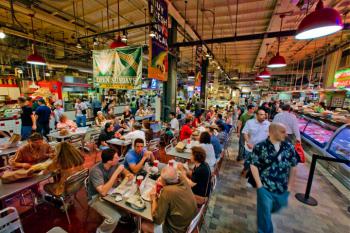

Remote Ready Biology Learning Activities

Remote Ready Biology Learning Activities has 50 remote-ready activities, which work for either your classroom or remote teaching.
What's New? Subscribe to Serendip Studio
A Random Walk
New Topics
-
4 days 20 hours ago
-
4 days 20 hours ago
-
4 days 20 hours ago
-
4 days 20 hours ago
-
1 week 19 hours ago
