
Serendip is an independent site partnering with faculty at multiple colleges and universities around the world. Happy exploring!

My thoughts on Ecofeminism
When Anne read some information about ecofeminism and speciesism, I found myself immediately rejecting and judging those ideas. I couldn't accept that the next step in equality and inclusion was animals. It sounded ridiculous to me. Why and how would we extend rights to animals? And as Christina said, plants are living too. Including certain non human species in equal rights but not others is just another line to draw. After I left class, I remembered learning about the waves of feminism in my women in history class at high school, and the critiques they received. In the first wave, when women wanted to be able to participate in the public sphere, they were accused of trying to wreck the entire structure of the American family, and therefore the country. I think that every new branch or type of feminism is going to have a counter argument. Sometimes other types of feminists are the ones arguing. I don't want to think of myself as acting/being against a group of feminists, like ecofeminists, but I their ideas don't follow what my feminism is. I hadn't heard any categories besides first, second, and third wave until class on Thursday, and I guess the idea of there being new groups still forming confuses me. Feminism as an ongoing movement seems so different from what we read about in history, and I am having a hard time placing myself. I dont want to be in a box for my type of feminism.

More than ten minutes of research (only those willing to subvert the rules of the assignment should read on):

Consider
1) An artist (Dove Bradshaw) claims a fire hose in the Metropolitan Museum of Art as a work of art.
2) She posts a label next tot he hose, and replaces it whenever it is removed.
3) She photographs her work and has postcards printed. She (secretly) deposits these postcards in the museums own gift shop. And they sell them. For years.
4) The museum acquires a photograph of the firehose and accepts it (the photograph) into its collection.
5) The firehose itself is later acquired by the museum that owns it; the artists work is donated to the museum, which is acknowledges in letters to the donor.
6) An artist book is created in an edition of 10 to document the trajectory of this project, which is now called a performance.
7) The book is published free online and you can peruse its 86 pages.

"Don't stare, its rude" or so we are told
As children we are frequently told not to stare because it is rude. However, the brief 4 minute video clip by Rosemarie Garland-Thomson, a professor at Emory I watched for next week's class confirmed my suspicion that staring is a natural desire. This instinct reflects the desire our brains have to absorb as much of a novel stimuli as possible. No matter how natural it may be, if an action does not conform to society's pre-determined norms, then we are told when we are young and malleable that it is not appropriate. Unfortunately in many cases this fact is true for other things as well, including the discussion of sex, gender, sexuality, etc. Although this conversation takes place relatively openly at Bryn Mawr, this occurrence is not common outside of the Bryn Mawr bubble. I repeatedly realize this statement each time I go home for winter or summer break. Where I come from the conversation does not flow freely. The conversation does not flow freely because society has deemed that it is an inappropriate topic. Soceity restricts itself, even though the origins of these restrictions were "to keep people safe." This statement ironically makes the assumption that we are not safe from ourselves: our own thoughts and our own actions. As a scientist I find it strange that humans, who are at the top of almost every ecosystem food or energy chain, are our own worst enemies.

About Marcel Duchamp
I was going to do some research on surrealism, but Marcel Duchamp suddenly jumped into my sight. His pieces as well as his lifestyle have some really intriguing parts.
According to the research, he wasn't intending to be an artist while growing up, and only did so because he wasn't willing to serve for the military. When he went to the art school, his talent didn't seem to be discovered, he tried different styles, including fauvist (I also noticed he later married the post-daughter-in-law of Henry Martis and Martis was the founder of fauvism), impressionism, post-impressionism.
Later he figured these traditional arts were not what he likes, and decided to create something new. He mocked the traditional art----he added mustache on Mona Lisa and claimed that there's no perfection in art, this idea later made him the representative of Surrealism and Dadaism. The action of sending a photo named Fountain (which is a picture of a urinal) to the museum was a mock of traditional art.
He is considered one of the authorities of the long history of art while proposing to put aside the authority and make art without bounded by the previous art pieces. As one the most influential artists, Marcel has being playing with art and did creations that challenged the art field in his own way.


Penis Headband
I had walked into Condom Kingdom without a reason for going in or an objective; this was not a shopping trip. Yet, I stood there holding a headband that was adorned with two sparkly pink penises and considered buying it. I could wear it on the blue bus, eat dinner in Erdman with it on my head, and even incorporate it into my Halloween costume. To me, the headband exemplified everything that the name “Condom Kingdom” implies: a light-hearted, humorous approach to sexuality. Owning it would not only make my friends laugh, it would be a way to work against the repression of female sexuality. Although I did not know it then, I was demonstrating Flanagan’s terms, “play” and “critical play,” and experiencing the effect of the city on “critical play” and one of the flaws of “critical play”.
Flanagan defines “play” when she writes, “In play, the aim is play itself, not success or interaction in ordinary.” Unlike Flanagan’s qualification for “play,” I believed I was playing in Condom Kingdom because I was having fun. Still, both definitions constitute my experience as a playful one; since I went into Condom Kingdom to play (not to bond with my other group members or to buy an item), I was playing for “play itself.”

What is Play?
What is Play?
Yijing Lu
When I am reading that part of the definition of “play” in Critical Play by Mary Flanagan, many experience and ideas of my trips to Philadelphia jump into my brain. I never tried to make any relationship between my experience of play and theories from books before. However, I have to admit that it is exciting and meaningful to combine some definitions and actions to achieve something new of feedback.
“Play is a notoriously difficult concept to define; it is a culturally and socially specific idea.”
I agree with this opinion. “Play” is an abstract word that can be considered as games of various sorts, or can be treated as kinds of actions for fun. In this sentence above, the author mentions “culturally” and “socially”, and I want to add one more word “personally”, because in my opinion, “play” can be defined by every individuals. For example, playing piano can be a kind of “play” for people who are good at or enjoy it, but it also can be a kind of torment for a poor girl who is compelled to learn piano by her strict mother. In other words, if you like, everything can be a kind of playing --working can be a kind of playing, because you may get a sense of achievement; studying can be a kind of playing, because you may enrich your knowledge; reading can be a kind of playing, because you may widen your horizon; and, even sleeping can be a kind of playing, because you may have an amazing dream!

Really By Chance?
I did some research about Dada, especially the artist Arp. There is some discussion about whether he's really create his work by chance?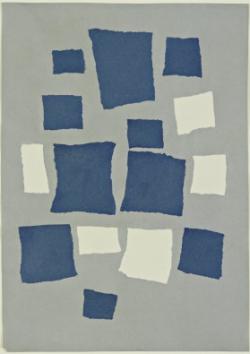
http://www.francois-murez.com/compoarp%20en.htm
some one analyze the art from Arp. To most of them,it's hard to believe Arp created his work really by chance. The golden section applys a lot in his work. When the people really try to create things like Arp did, "It doesn’t work. The squares never land where they should. We always feel compelled to adjust the spaces between the papers, moving them closer together or further apart." (http://artofcollage.wordpress.com/2012/04/25/collage-according-to-the-laws-of-chance/)
10-minute research: George Braque
http://en.wikipedia.org/wiki/Georges_Braque
Braque believed that an artist experienced beauty "… in terms of volume, of line, of mass, of weight, and through that beauty [he] interpret[s] [his] subjective impression...”He described "objects shattered into fragments… [as] a way of getting closest to the object…Fragmentation helped me to establish space and movement in space”.He adopted a monochromatic and neutral color palette in the belief that such a palette would emphasize the subject matter.

10 Minutes of Research: Dada Movement and Marcel Duchamp
The Dada movement was an artistic movement, that centered itself around the idea of being anti-art. It aimed to offend, to shock, to critisize, to disturb the senses; if art did one thing, Dada aimed to do the other. This was in protest to what the Dada artists thought of as a world slowly killing itself, a borgiuazie who would rather fight a war with itself than change how the society works.
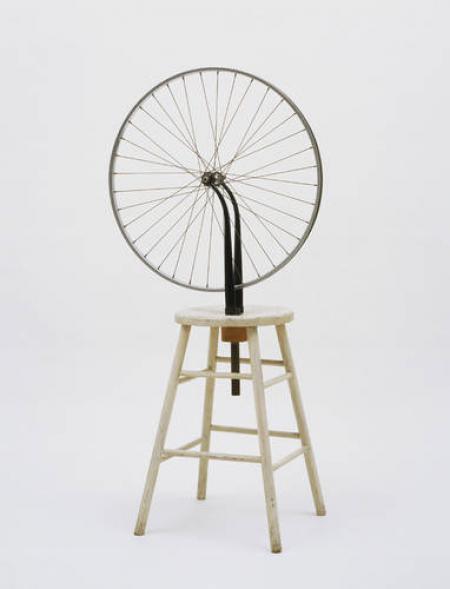
Of those artists, one whom I find particularly interesting is Marcel Duchamp, the infamous artist behind "The Fountain", a urinal hung on a museum wall with a fake signature. He also created a piece called "Bycicle Wheel", currently on display in New York's Museum of Modern Art; when that sculpture was originally displayed, the artist invited viewers to interact with and spin the bycicle wheel, although that is no longer allowed now that the piece is displayed in MoMA.

Barbie Liberation
One of the questions we played w/ yesterday was whether we are the dolls of the endless, or whether they they are ours (cf. Rose's musing, p. 222, "we're just dolls," with Morpheus' telling Desire, p. 226, "We of the endless are the servants of the living...we are their toys. Their dolls....").
In this context, I thought this story about the Barbie Liberation Organization (just uncovered by my co-teacher in Play in the City, Mark Lord) might amuse/interest/enbolden you. A number of activist-artists attained possession of Barbie and G.I. Joe Dolls, switched their voiceboxes, then re-boxed and returned them to store shelves. So some little girls got Barbie Dolls who talked like men about war and fighting, and some boys got "fighting man" dolls who would say (in a prissy girl voice), "Math is harrrd." Dolls have agency, too!
Here's film:
http://www.youtube.com/watch?v=eMHMf9y-27w

Remote Ready Biology Learning Activities

Remote Ready Biology Learning Activities has 50 remote-ready activities, which work for either your classroom or remote teaching.
What's New? Subscribe to Serendip Studio
A Random Walk
New Topics
-
4 days 20 hours ago
-
4 days 20 hours ago
-
4 days 20 hours ago
-
4 days 20 hours ago
-
1 week 19 hours ago
