
Serendip is an independent site partnering with faculty at multiple colleges and universities around the world. Happy exploring!

Rose and thorns/today's discussion
What I really like about our class is that the topic is so broad and important that we can almost always find a way to link our everyday concerns to the discussion - and through many physical and virtual platforms. It gives a sense of flexibility and creativity but also requires great responsibility for everyone to actively contribute to the class's discussion.

10 minutes of research 3: Yes Men, Ladies Against Women, and the Barbie Liberation Organization
Flanagan mentions The Yes Men. Here's video of the outcome of one of their stunts.
or here: http://rt.com/usa/yes-men-bank-people-510/
During the Reagan administration, which none of the students in this class will remember, women who felt as if their rights were being cut back started a group called LADIES AGAINST WOMEN. They would go to places where the first lady was appearing and they would "protest" against the rights of women, making the positions of those who actually opposed womens' rights look...silly. Here is footage of some of these women at a parade, not in the context in which they usually performed.
http://www.youtube.com/watch?v=kxlYKR0zZVM
Flanagan does not mention the Barbie Liberation Organization, but she might have. A number of activist/artists, working in secret, attained possession of Barbie Dolls and G.I. Joe Dolls (American soldier dolls for boys) and switched their voiceboxes, after which, thety re-boxed them and put them on store shelves. So lots of little girls got Barbie Dolls who talked like men about war and fighting...and lots of boys got "fighting man" dolls who would say (in a prissy girl voice), "Math is harrrd."
Here's film:

final thoughts on Sandman
I'm still trying to figure out where I stand on this book regarding what it means overall to our main topic. Persepolis, while first and foremost an autobiography, definitely included a gender-based narrative as Marjane grew older. For my part, I couldn't see the same in The Doll's House. Certainly there was a discussion of identity - how the boarders in Rose's home presented themselves to the world versus how they dreamed themselves, in particular. And of course there were the very gendered scenarios, like the story of Dream as told by the tribesmen in the beginning (leaving me wondering how the women's half of the story in their unique language would be told), or like Rose's would-be assault at the hotel. To compare Bornstein and Gaiman, the biggest similarity would be Desire, the genderless 'sister-brother' of Dream who appears in the last few pages. And from what little I know of Desire, this agenderism could be the basis of its own discussion. Why is Desire genderless - perhaps to prove that any gender could seek the same things for whatever motive? Actually, I wonder more if Desire is every gender at once. Dream called Desire 'sister-brother' instead of 'siblings', implied a dual truth in both terms. After Desire, the next most notable example would be Ken and Barbie and their stiffly-gendered dreams. In waking life, they appear almost as a single entity, sharing thoughts and finishing sentences, but in dreams, Ken becomes aggressive and violent (stereotypically male), and Barbie enters an extravagant fairy tale world.
10 minutes of research 2: John Cage
John Cage's work is really important to me. In addition to introducing "chance operations" into his work, his Zen-influenced attitude towards making art and living in the world have inspired and emboldened a lot of my play in the worlds of theater and dance.
In this video, which is from a 1960 American TV show called "I'VE GOT A SECRET," American celebrities of the time play a game of trying to figure out what a "mystery guest's" secret is. So there's the American TV game to see (in all its hokey splendor), but also John Cage's compositon, which I find delightful for how seriously it takes play.
If this isn't embedded, visit it at http://www.youtube.com/watch?v=SSulycqZH-U
10 minutes of research 1: Henri Matisse
Flanagan describes Henri Matisse as a "traditional artist" and I want to register my disagreement. His painting so offended the mainstream critics of his day that they referred to it as "fauvism," the work of "wild animals." Although he used paint and canvas, his strategies for representation were wildly opposed to the impressionists, whose pretty canvases his playfully oppose.
Consider this painting of his wife and its play with color.
http://ayay.co.uk/background/paintings/henri_matisse/portrait-of-the-green-stripe/

Sophie Taeuber-Arp
Her collection:
http://www.moma.org/collection/artist.php?artist_id=5777
video:
http://www.youtube.com/watch?v=vvwFuwOdkzE
from wikipedia:
In 1915, at an exhibition at the Tanner Gallery, she met the Dada artist Jean Arp, with whom she was to collaborate on numerous joint projects until her death in 1943. They married in 1922 and she changed her last name to Taeuber-Arp.
...
During this period, she was involved in the Zürich Dada movement, which centered on the Cabaret Voltaire. She took part in Dada-inspired performances as a dancer, choreographer, and puppeteer; and she designed puppets, costumes, and sets for performances at the Cabaret Voltaire as well as for other Swiss and French theaters. At the opening of the Galerie Dada in 1917, she danced to poetry by Hugo Ball wearing a shamanic mask by Marcel Janco. A year later, she was a co-signer of the Zurich Dada Manifesto.

Hannah Hoch
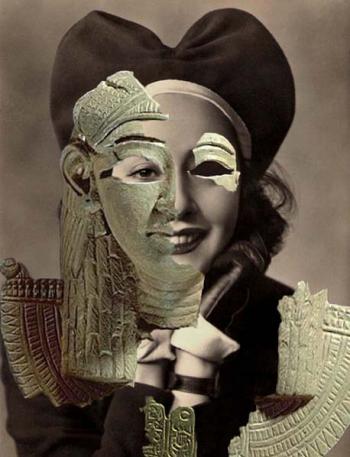
Hannah Hoch was a German photocollage artist and part of Dada art movement in Europe. The Dada art movement was in responce to World Word I. During World War I Hoch wad a nurse with the Red Cross. Hoch was one of the orginators of photocollage art along with Raoul Hausmann. Her work mainly features women and machine parts.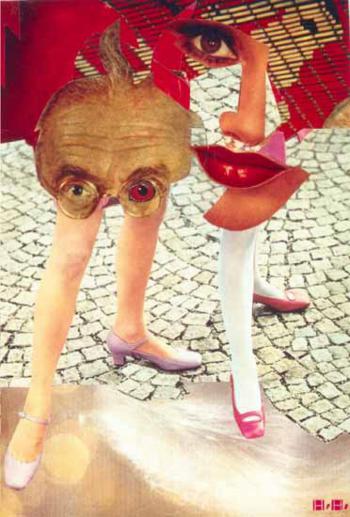

New Games Movement

"Play Hard, Play Fair, Nobody Hurt." This is the central philosophy of New Games Movement. One of its founders was Stewart Brand, well known for being the editor of the Whole Earth Catalog. It started in the late 1960s and became popular a decade later. I found the principles of this movement fascinating, because one of them proposed that although play included competition, winning or losing in the end was not important. Also, the movement pursued to replace competitive sports with cooperative games. The game "Slaughter" would be a good example. In this game, people on the winning side were encouraged to change to the losing side, ensuring there were no winners or losers. This is a really interesting idea.

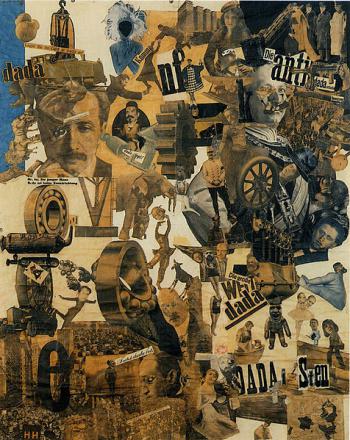
Some information about Dada
The word ‘Dada’ is strange for me. When I read it, the word seems meaningless and is onomatopoetic. After I read the article, I found some information about this movement. I’m interested in the link between art and the war. Artists who started Dada wanted to use this movement to express their feeling, their weariness and horror against the WW1. Those people worked against the main stream, because they thought the main stream thoughts reflected the ideas of persons who caused the war. The attitude was negative to everything. They gave up the logic, and wanted to destroy. The obvious person in the movement I noticed is Hannah Hoch, a German Dada artist. Actually at that time, many male members in the movement believed ‘paid lip service to women's emancipation’, it was not easy for her to take part in. In her work, she expressed not only the idea of Dada, but also the idea of feminism.


Innovating Pedagogy 2013: Seamless learning
 The Innovating Pedagogy report is an annual overview of edutech from the Institute of Educational Technology at the Open University. The 2013 report, the second in the series, selects 10 emerging innovations from the long list of existing technologies which the institute believes have the potential to make a significant impact on education. These are not technologies which are in development or even new, but rather technologies and ideas which are already being effected but have room to expand. The report ranks each innovation in terms of potential impact and timescale for implementation, describes its current application, and then explains the pedagogy behind the innovation and how it could be re-envisioned for maximum impact. The fourth innovation which the report discusses is the growing phenomenon of seamless learning.
Potential impact: medium/high
Timescale: medium (2-5 years)

Remote Ready Biology Learning Activities

Remote Ready Biology Learning Activities has 50 remote-ready activities, which work for either your classroom or remote teaching.
What's New? Subscribe to Serendip Studio
A Random Walk
New Topics
-
4 days 21 hours ago
-
4 days 21 hours ago
-
4 days 21 hours ago
-
4 days 21 hours ago
-
1 week 20 hours ago
