Serendip is an independent site partnering with faculty at multiple colleges and universities around the world. Happy exploring!

Anne Dalke's picture

"Why not revel in the alternatives?"

If I were still putting together lecture notes to share with y'all, I'd be sure to mention a New Yorker article called "The Possibilian," about a neuroscientist named David Eagleman who says that "Science had taught him to be skeptical of cosmic certainties.... From the ..'alien computational material' [that is brain tissue] to the mystery of dark matter, we know too little about our own minds and the universe around us to insist on strict atheism.... 'And we know far too much to commit to a particular religious story.' Why not revel in the alternatives?....'Part of the scientific temperament is this tolerance for holding multiple hypotheses in mind at the same time.....

Oak's picture

Class notes, 3-14

phreNic's picture

Reflections

 In my reflection over this course I tried to discover what had made me most uncomfortable and why. The materials themselves were interesting and fresh perspectives on topics I have given a great deal of thought. The best I was able to come up with was that the online conversations felt naked and premature. This is not an observation of other’s postings, but of my own contributions. In true Haraway fashion, I was best able to relate my reservations to metaphor.

phreNic's picture

the universe as a metaphor

 We have used the universe as a metaphor for the internet. If I were to take that to as much an extreme as a non scientist can, I would say that you could relate the stars, planets, satellites, black holes, even galaxies to the many groupings of people, information, and blogs. But the structure, the internet as a thing, the wires, circuits, and waves, the hardware and software, must exist in that metaphor to fully capture the concept. To be fair, we have no way of counting the stars in our entire universe. So to be able to represent it visually, and to bring it to a level that we can better grasp, let us focus first at or galaxy, and than look to our visible sky. 

joycetheriot's picture

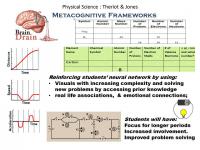
Metacognitive Frameworks

Metacognition slide 

Metacognition slide


I presented a snapshot of my research this year to the faculty at my high school.

phreNic's picture

Gender construction and the internet

RL gender construction

 Simone De Beauvoir was adamant in her conviction that people and gender are constructed by our experiences and the influences of the society in which we live. As our world becomes more digital and interconnected, how we experience the world is changing. For some, like the character Zaboo in the web series The Guild, they have experienced life primarily through technology.

RL gender construction
phreNic's picture

My Latin Mind

 In my struggle to learn the Latin Language, I tried various study materials but found myself spending too much time adjusting them to my own understandings and connections. 

ekthorp's picture

Inside and Out: Gender, Information, Science and Technology in Metropolis And Contemporary Images

http://www.youtube.com/watch?v=pOf3kYtwASo


          In the film Metropolis, made in 1927 by Fitz Lang, is possibly the most influential Science Fiction movie of all time. Technology and gender intersects often in this film, creating a forum to ask broader questions about gender, technology, science and information. Beyond just the academic studies of this film, however, there are ways this eighty year old film and themes from Gender, Information, Science and Technology all intersect within a contemporary popular music video, Jessie J’s “Do It Like a Dude.”

http://www.youtube.com/watch?v=pOf3kYtwASo
Hilary_Brashear's picture

diGISTion

See video

Web Event 4: Final Project

diGISTtion

See video
Vivien Chen's picture

From Reality to Randomness

 "Death and life have their determined appointments; riches and honors depend upon heaven." - Confucius

Syndicate content